World Chess Championship 2026 · Fondation Martin Bodmer, Cologny, Genève
White: Sindarov, Javokhir · Black: Gukesh D
Game 1 · · Completed ½–½
Compare Gukesh and Sindarov · World Chess Championship history
GAME 1 · GAME REPORT
Game 1: forty minutes, one brave king and a first-day draw
Sindarov tested the champion’s memory, patience and clock in a tense Berlin Endgame. Gukesh answered with a long think, a precise defensive plan and the game’s most memorable move.
- Result
- ½–½ · 38 moves
- Colours
- Sindarov — White · Gukesh — Black
- Opening
- Ruy Lopez · Berlin Defence
- Match score
- ½–½
The scoreboard says ½–½ after 38 moves. The fuller story is of a challenger trying to make time itself a weapon, a champion willing to spend it to solve the position, and a black king walking to f6 just when White’s attack appeared ready to open.
A cautious choice, not a quiet game
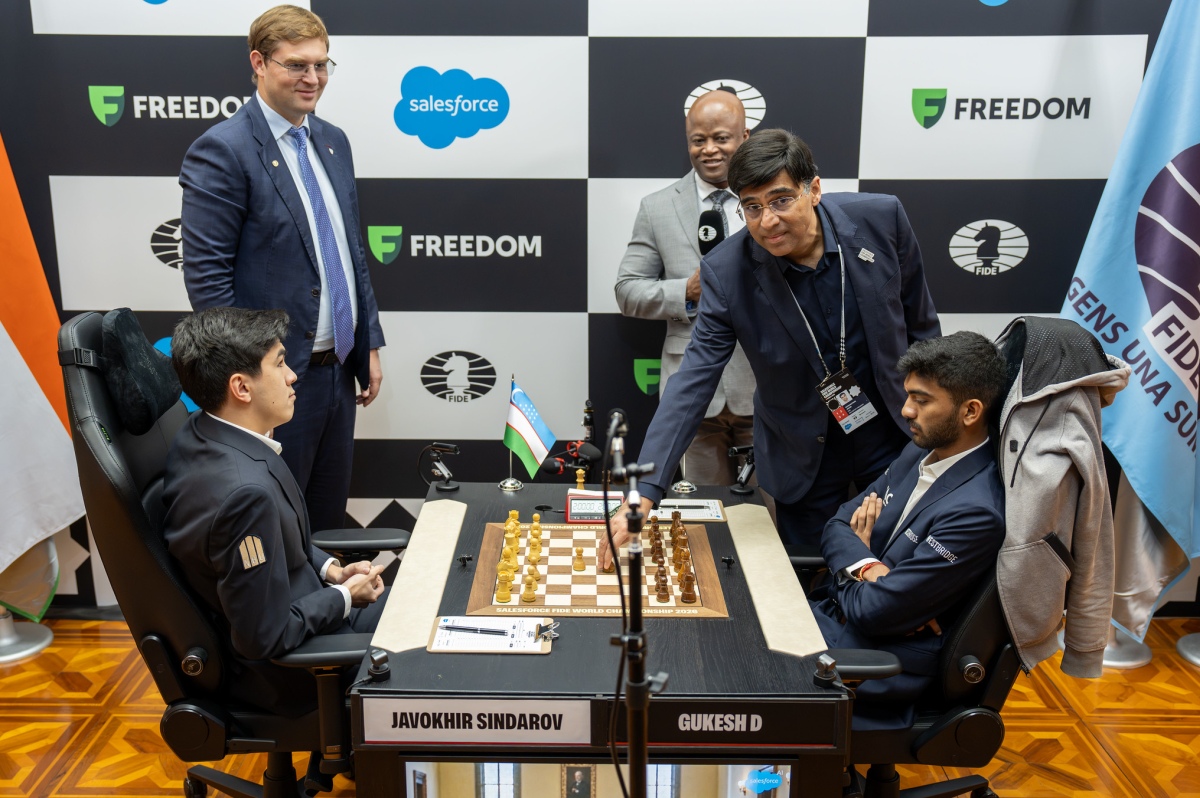
The ceremonial moves—1.e4 by FIDE President Timur Turlov and 1…e5 by five-time world champion Viswanathan Anand—turned out to be exactly what the players wanted. Sindarov steered the opening into the Berlin Endgame, the famously durable branch of the Ruy Lopez that Vladimir Kramnik used as a match weapon against Garry Kasparov in 2000.
That choice was revealing. Sindarov later said the first game was partly about learning the opponent and settling into the hall. Research cited at the press conference noted that, despite many earlier opportunities, this was his first recorded choice of 6.Bxc6. He was not refusing a fight; he was choosing a position in which he could keep control while asking Gukesh to solve a long series of small problems.
The first genuinely fresh question came with 13.Ne4. Gukesh knew the idea, but admitted he had underestimated some of its force. His reply, 13…Bd7, made Sindarov stop in turn. The challenger chose 14.c4, although after the game he preferred the more concealing 14.Rd2. Already the opening had become a negotiation: each player was trying to discover how much the other remembered and what he would do once memory ended.
The forty-minute decision
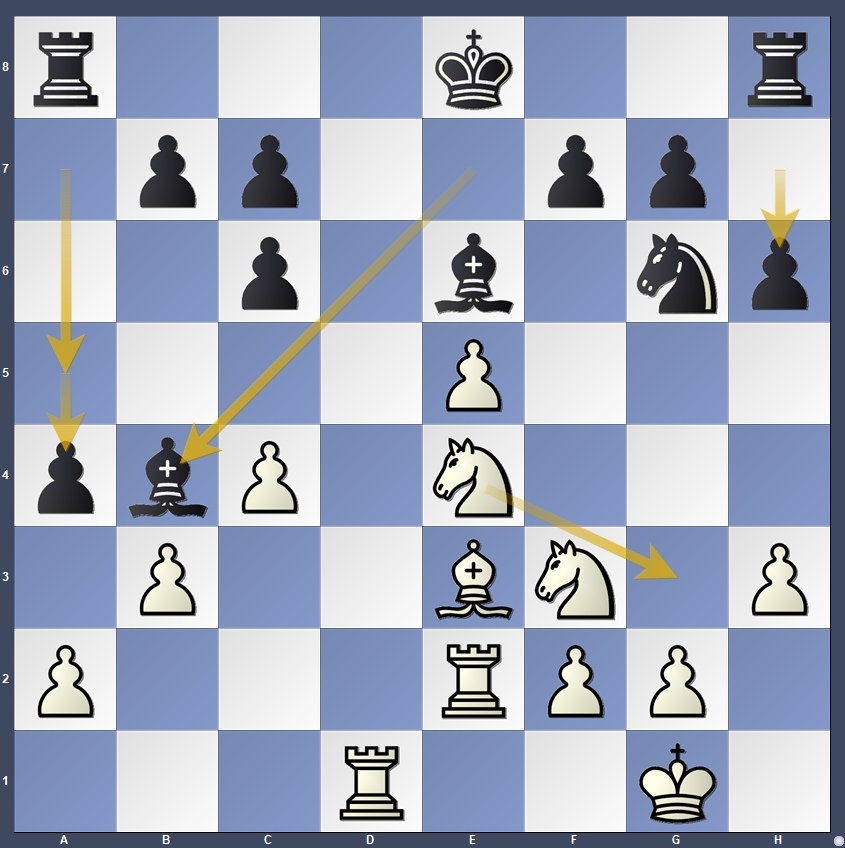
The game’s rhythm changed after 17.b3. Gukesh spent close to forty minutes working through White’s twin ideas of Nd4 and Ng5. On a clock, the gap looked alarming. On the board, the time bought a solution: 17…Bb4, followed by …h6 and …c5. Together those moves restrained White’s knights and removed the most direct route into Black’s position.
Sindarov did what a strong match player should do when his opponent falls behind on time. He kept the position alive. The knight travelled through g3 and h5, the kingside pawns advanced, and 22.Ne1 introduced a new tactical idea. Gukesh called that retreat “super, super interesting.” The move looked modest, but it prepared f4 and forced Black to calculate rather than coast toward equality.
The clock disparity mattered, but not in the simplistic sense that the slower player was losing. Gukesh explained that he had mapped out several of the coming moves during the long think. Once the position demanded speed, he was able to find it. Sindarov had practical pressure; Gukesh had purchased clarity.
Why 27…Kf6 changed the story
Black’s 23…Nxe5 allowed the position to open. After 24.f4 g6 25.Ng3 Nc6 26.f5 gxf5 27.Nxf5+, the natural human reaction is to worry about the exposed black king. Gukesh instead stepped forward with 27…Kf6. The king did not retreat from the attack; it became part of the defence.
Sindarov said he had not evaluated the move correctly and found the king unexpectedly secure on f6. Gukesh’s own verdict was even more confident: “I thought I was more than safe.” That contrast explains the moment. White had succeeded in creating the appearance of danger, but Black’s pieces covered the entry squares and the king’s central position helped connect the defence.
For viewers who do not speak chess notation, the point is simple: Sindarov had opened lines and appeared to be chasing the king. Gukesh recognised that the apparent exposure was an illusion. By walking toward the centre, he removed White’s most forcing checks and made the attack run out of targets.
One last chance—and the correct escape
Gukesh briefly became optimistic after 31…Bc3. Black’s active pieces suggested that the defender might become the one pressing. Sindarov responded accurately with the checking sequence built around 33.Rg5+ and 34.Rh5. The rook reached a square from which White could repeat the position rather than accept fresh risk.
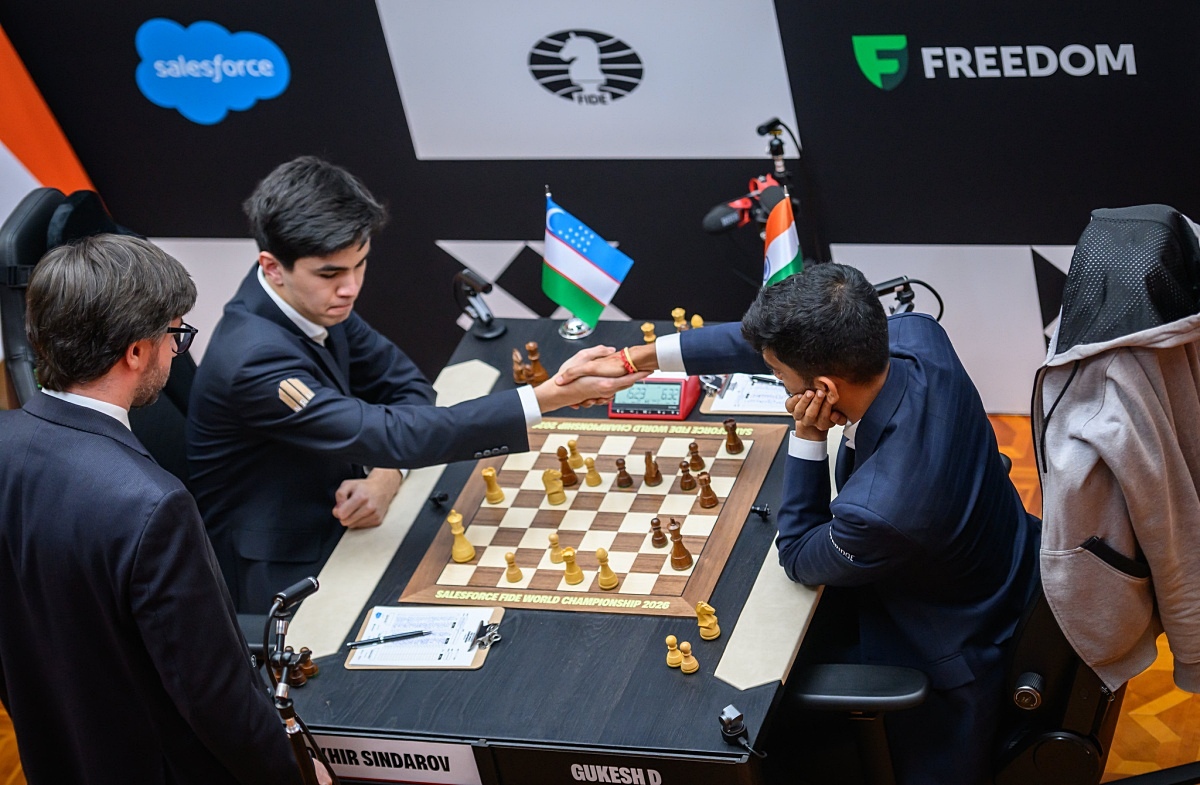
There was a small procedural coda. Sindarov made an incorrect threefold-repetition claim, so the arbiter added two minutes to Gukesh’s clock and restarted play. The draw was properly secured two moves later. It was not a chess error and did not alter the result, but it added an oddly human final beat to a game otherwise defined by exact calculation.
After 38 moves the match stood level. Sindarov had shown that he could make a solid opening choice feel uncomfortable and use a clock advantage to sustain pressure. Gukesh had shown the trait that carried him through his first title match: patience in an awkward position, trust in calculation, and the nerve to defend actively when passive moves would have been easier.
WHAT GAME 1 TOLD US
A draw was the fair result, but not an empty one. Sindarov proved he could dictate the practical questions with White; Gukesh proved he could answer them without panic. The match began not with a breakthrough, but with both players establishing the qualities the other will have to overcome.