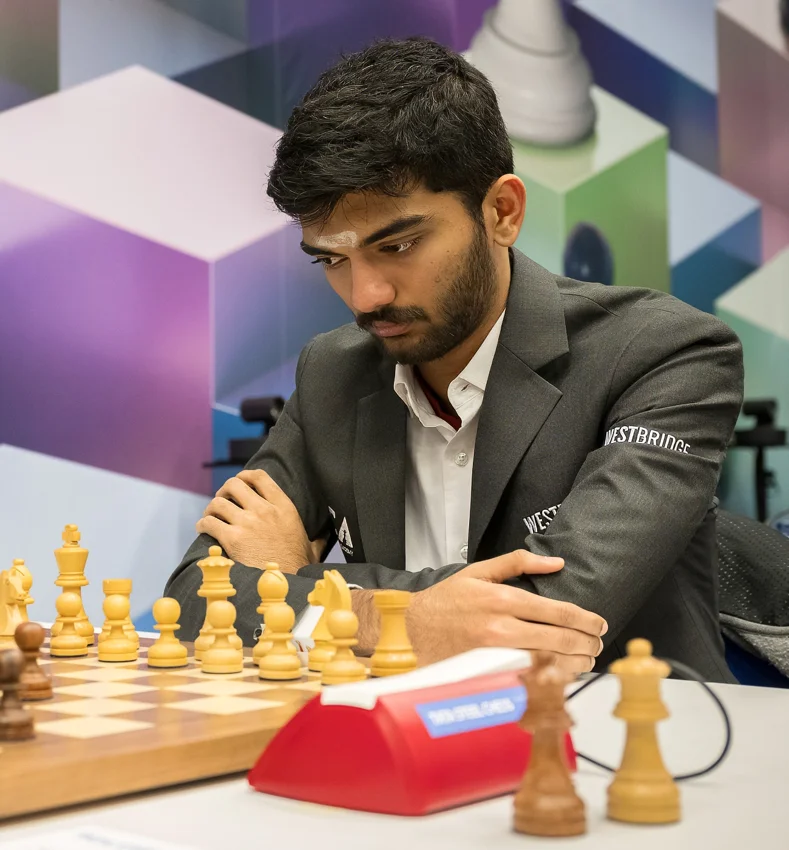
 Champion · India
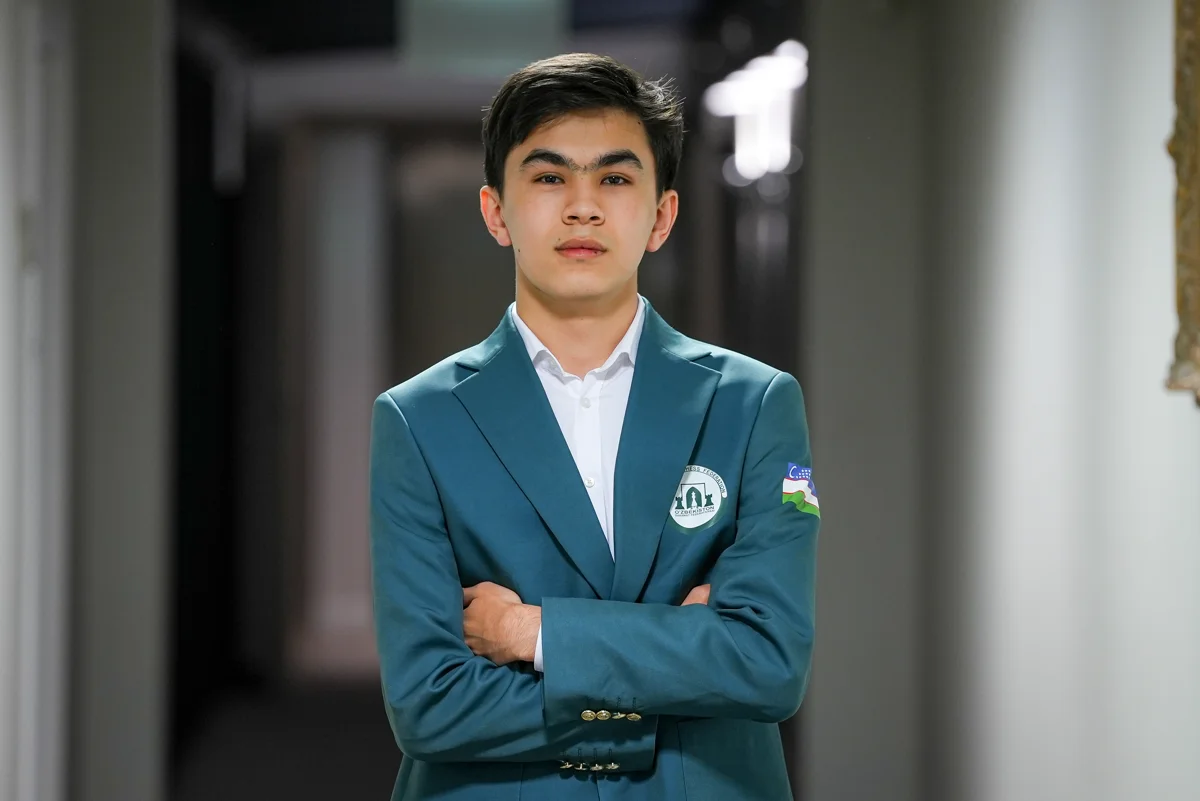 Challenger · Uzbekistan
WORLD CHAMPIONSHIP · 2026
Gukesh vs Sindarov: two roads to the World Championship
Two 20-year-olds arrived through different systems of pressure. This is the pre-match evidence behind their careers, chess and contrasting routes to Geneva.
Gukesh Dommaraju and Javokhir Sindarov are both 20. Both became grandmasters before turning 13. Both won gold at the 2022 Chess Olympiad in Chennai. Now one arrives in Geneva as the youngest world champion in history, while the other arrives as an unbeaten Candidates winner and the higher-rated player.
Before the 2026 FIDE World Championship began, the comparison appeared unusually stark: Sindarov arrived as the higher-rated, in-form challenger, while Gukesh brought the crown and the experience of already surviving a 14-game title match.
The pre-match questions extended far beyond a single opening game. Could Sindarov convert superior recent form into sustained pressure across a match? Could Gukesh make the contest about resilience, calculation and long games rather than the rating list? And how would six months of targeted preparation change players whose public games suggested such different trajectories?
The match is scheduled for 14 classical games. The first player to reach 7½ points becomes world champion; a 7–7 score sends the contest to faster tiebreaks.
THE CONTEST IN FOUR NUMBERS
Form points one way. Match memory points the other.
What this match is really about
For Gukesh, the match is an attempt to separate the player he is in a championship contest from the results he accumulated after becoming champion. He is not only defending a title. He is defending the proposition that the qualities required to win this particular contest—deep preparation against one opponent, emotional recovery, stamina and the willingness to keep calculating under pressure—are not perfectly measured by a monthly rating list.
For Sindarov, it is the first time that a lifetime of promise becomes a direct claim on the crown. He has already proved that he can survive a month-long knockout, win an elite round robin without losing and climb into the world’s top four. What he has not experienced is the strange repetition of a world-title match: the same opponent every day, an opening idea answered overnight, a weakness returned to four games later, and no new pairing to reset the psychology.
Every game is also an information exchange. The players learn how quickly the other is seeing positions, how much of an opening has been anticipated, whether the opponent is seeking safety or conflict, and how each reacts when preparation ends. Across 14 games, those observations can become almost as valuable as half a point.
There is also a larger historical meaning. Gukesh and Sindarov belong to the first generation whose elite chess education was computer-native from childhood. Yet the match sets two distinct development cultures against one another: the Indian system that expanded in Anand’s wake, and the Uzbek system whose young national team won Olympiad gold in 2022 and again finished ahead of India in 2026. Their ages make the match novel; the institutions behind them make it consequential.
Gukesh vs Sindarov: profile comparison
| Category | Gukesh Dommaraju | Javokhir Sindarov |
|---|---|---|
| Age | 20 | 20 |
| Federation | India | Uzbekistan |
| Role | Defending world champion | Challenger |
| Rating entering the match | 2710 | 2782 |
| World ranking entering the match | No. 26 | No. 4 |
| Peak published rating | 2794 | 2782 |
| Became a grandmaster | 12 years, 7 months | 12 years, 10 months |
| Route to Geneva | Won the 2024 Candidates; defeated Ding Liren in the 2024 title match | Won the 2025 World Cup; won the 2026 Candidates unbeaten |
| 2022 Chennai Olympiad | Individual gold on board one; India 2 won team bronze | 6½/10 on board three; Uzbekistan won team gold |
| Classical head-to-head | 0 wins, 1 draw, 2 losses | 2 wins, 1 draw, 0 losses |
Ratings and rankings are the published figures in FIDE's pre-match preview. They are useful measures of current competitive strength, not guarantees of match performance.
The champion: Gukesh’s accelerated road from Chennai
Gukesh learned chess at school in Chennai at seven. His rise was rapid even by the standards of India’s exceptional young generation. He won the under-nine section of the Asian School Championship in 2015, became an International Master in 2018 and completed the grandmaster title in January 2019 at 12 years and seven months.
The wider chess public saw the scale of his potential at the 2022 Olympiad in Chennai. Playing board one for India’s second team, Gukesh began with eight consecutive wins and finished on 9/11. He earned individual gold and helped his team take bronze.
In 2023 he crossed 2750 and qualified for the next Candidates through the FIDE Circuit. Seeded sixth by rating in Toronto, he scored 9/14 and won the 2024 Candidates at 17. Later that year, he added another board-one gold while India won team gold at the Budapest Olympiad.
The Singapore title match against Ding Liren supplied the defining moment. The score was level entering Game 14. Ding’s 55.Rf2 allowed a simplifying sequence into a lost pawn ending, and Gukesh won 7½–6½ to become world champion at 18.
His time as champion has not followed a clean upward line. Gukesh shared first place in the classical section of Tata Steel 2025 before losing the playoff to Praggnanandhaa, but his rating and ranking have since fallen markedly from their peak. The central question in Geneva is whether those tournament results describe his present level—or whether the long-match environment activates the discipline, calculation and emotional recovery that carried him through Toronto and Singapore.
The family decision behind the rise
The speed of Gukesh’s ascent can obscure the infrastructure that made it possible. His parents, Rajinikanth and Padma, are doctors. As tournament travel became essential, his father stepped away from regular work to accompany him, and Gukesh left conventional schooling to concentrate on chess. This was not an isolated prodigy simply moving faster than everyone else; it was a family reorganising its life around a child’s exceptional trajectory.
That history helps explain why Gukesh repeatedly speaks about the team rather than presenting preparation as a solitary act. Grzegorz Gajewski has been the most visible chess figure in that group. Paddy Upton, the performance coach who had worked with India’s 2011 Cricket World Cup team, was part of the 2024 championship effort. Viswanathan Anand and the WestBridge Anand Chess Academy supplied another layer of guidance and institutional memory.
Gukesh’s childhood objective was unusually explicit: he wanted to become the youngest world champion. Achieving it at 18 removed the organising ambition of more than a decade. His subsequent results therefore invite a question that is psychological as much as technical: what replaces the goal after the life-defining goal has already been reached?
In a 2026 interview about his form, Gukesh acknowledged that some of his strengths had begun to control him. Ambition can become overpressing; confidence in calculation can become an unwillingness to accept that a position offers no more than equality. That self-diagnosis matters more than the familiar claim that he is simply “out of form.” It identifies the adjustment his match team must make without erasing the qualities that made him champion.
The challenger: Sindarov’s rise from Tashkent
Sindarov learned chess at four in Tashkent and won the under-seven section of the Asian School Championship. He became an International Master in 2017 and a grandmaster in 2018 at 12 years and ten months.
His early career contained several signals that he could trouble elite opposition. He won the Uzbek national championship in 2019 and eliminated Alireza Firouzja from the 2021 World Cup. At the 2022 Olympiad, his 6½/10 on board three helped Uzbekistan win the open team gold—the same event at which Gukesh won individual board-one gold.
The breakthrough into the championship cycle came in Goa. Sindarov won the 2025 World Cup, defeating Wei Yi in the final and earning a place in the Candidates. In Cyprus in 2026, he then produced the result that defines his challenge: six wins, eight draws, no losses and 10/14. A Round 5 victory over Hikaru Nakamura built momentum; a draw with Anish Giri in Round 13 secured first place.
Sindarov enters Geneva at a career-high 2782 and fourth in the world. Unlike Gukesh before Singapore, however, he has never played a world-title match. The Candidates rewarded consistency across 14 games against seven opponents. A championship match asks a different question: can he keep finding fresh problems against one opponent whose entire team has prepared for him?
The child who wanted another game immediately
Sindarov’s earliest chess memory is not of winning. At roughly four and a half, he accompanied a friend to a kindergarten chess class, learned the rules from his grandfather and entered a tournament within a week. He lost every game. His grandfather, Komil Sindarov, noticed his disappointment at the prize ceremony and gave him small gifts as an improvised award. Within six months, Javokhir was the strongest player in the family.
That story is useful because it contains traits still visible in the challenger: an attraction to games themselves, competitiveness that demands another attempt after a loss, and a family structure that treated early disappointment as something to work through. Sindarov has described much of his childhood memory as inseparable from chess. He also sees himself as broadly gifted at games, not only at memorising chess positions.
His coach Roman Vidonyak describes a player with fast, fearless decision-making and a natural sense of harmony. Their collaboration, which began in 2025, did not rely exclusively on feeding more engine variations into an already computer-literate player. Reporting before the match describes about nine intensive camps over 16 months, with long sessions at a physical board and substantial periods without an engine. The purpose was to make Sindarov articulate and solve positions rather than accept a machine’s answer.
Reporting on Vidonyak's training system describes days of eight to ten hours, alongside physical and psychological preparation. It helped produce a 53-game classical unbeaten sequence spanning the 2025 World Cup, Tata Steel 2026 and the Candidates. That run is evidence of more than caution: knockout survival, elite tournament consistency and the ability to recover between different competitive formats.
Sindarov’s preparation also carries the momentum of Uzbek chess. His 2022 Olympiad teammates were peers rather than distant role models. Nodirbek Abdusattorov, Nodirbek Yakubboev and other members of that generation created an environment in which beating established powers became a collective expectation. Geneva is an individual contest, but Sindarov arrives as the first Uzbek challenger with the confidence of a national chess project behind him.
TWO ROADS TO GENEVA
Their careers rose in parallel—then crossed.
GukeshChampion · India- Grandmaster at 12 years, 7 months
- Olympiad board-one gold
- Candidates winner and world champion
- First title defence
SindarovChallenger · Uzbekistan- Grandmaster at 12 years, 10 months
- Olympiad team gold
- World Cup winner
- Candidates winner, unbeaten
Two prodigies, two routes to the same board
The parallels are striking, but their routes diverged.
| Year | Gukesh | Sindarov |
|---|---|---|
| Childhood | Learned at seven in Chennai | Learned at four in Tashkent |
| 2018–19 | Became a GM at 12 years, 7 months | Became a GM at 12 years, 10 months; won Uzbek title in 2019 |
| 2021–22 | Broke through at the Chennai Olympiad | Eliminated Firouzja at the World Cup; won Olympiad team gold |
| 2023–24 | Qualified through the FIDE Circuit; won Candidates and world title | Continued building experience in elite events |
| 2025 | Began life as world champion | Won the World Cup in Goa |
| 2026 | Prepared for his first title defence | Won the Candidates unbeaten and reached No. 4 |
Gukesh reached the summit first. Sindarov reaches this match with the stronger immediate statistical case. That tension—not age—is the contest’s real starting point.
The form gap—and what the headline leaves out
The November list creates a dramatic image: Sindarov is 72 rating points and 22 ranking places above the reigning champion. No player ranked as low as Gukesh has entered a unified-era title match as champion. That is real evidence, and it cannot be explained away by the special nature of match play.
The path to those numbers, however, is more informative than the numbers alone.
| Period | Gukesh | Sindarov | Editorial reading |
|---|---|---|---|
| 2024 | Won the Candidates, board-one Olympiad gold and the world title | Still building toward regular elite invitations | Gukesh produced the stronger peak year |
| 2025 | Shared first in the Tata Steel classical standings, then produced inconsistent results | Won the World Cup and expanded his elite experience | Their trajectories began to cross |
| Tata Steel 2026 | Finished in the lower half; three wins, seven draws and three losses | Finished second with 8½/13 and a 2833-level performance | Same field, sharply different outcomes |
| Candidates 2026 | Ineligible as reigning champion | Won with 10/14: six wins, eight draws, no losses | Sindarov converted form into the right to challenge |
| Norway Chess 2026 | Finished last after five classical defeats and one win | — | The most damaging event in Gukesh’s decline |
| Chennai 2026 | Finished last in his home event without a win | — | Suggested the problem was not one bad tournament |
| Olympiad 2026 | Rebounded with a major plus score as India took silver | Led an Uzbekistan team that finished first | Both received a positive final competitive signal |
Gukesh’s late Olympiad recovery matters, but it has limits as evidence. Playing on a lower board reduced the density of top-ten opposition. It showed that he could win repeatedly again; it did not erase the technical questions created by Norway and Chennai.
Sindarov’s run is also not invulnerability. An unbeaten sequence can contain saved positions and missed chances by opponents. A match team will study those moments more closely than the final scores. Gukesh does not need to prove that Sindarov’s year was unimpressive. He needs to identify which kinds of decisions become less automatic when Sindarov cannot change opponents the next morning.
Why a match can resist tournament form
A tournament rewards adaptation to many styles. A match rewards depth against one player. Tournament form measures the positions a player actually encountered; match preparation is designed to change that sample.
Gukesh’s 2024 experience supplies a concrete example. He lost Game 1 to Ding after overestimating his position and struggling with nerves. He responded by winning Game 3. Later, he took the lead in Game 11 and lost it immediately in Game 12 when Ding produced his best game of the match. Gukesh did not collapse after either blow. He entered the final game level and kept playing a position many observers expected to be drawn until Ding made the decisive error.
That history does not guarantee recovery in 2026. It does show that “Gukesh is behind” and “Gukesh is finished” are not equivalent statements. Sindarov’s task is not merely to obtain an advantage. It is to keep making the champion solve new problems after the first emotional effect of that advantage has passed.
INTERACTIVE GAME · TATA STEEL 2026
The encounter that revealed both players.
In their final classical meeting before Geneva, Gukesh sacrificed his queen and created winning chances; Sindarov defended for 78 moves. Step through the critical phases.
SINDAROV ½–½ GUKESH
Starting position
Sindarov began with 1.d4 and the game entered a Queen’s Gambit Declined.
Game score: The Week in Chess. Commentary is editorial interpretation.
Their head-to-head record
The recorded classical games give Sindarov a 2½–½ lead in their rivalry.
- Moscow Open, 2018: Sindarov won their first recorded classical meeting. Both were still children, so the game belongs more to their shared origin story than to a forecast of the 2026 match.
- Sharjah Masters, 2022: Sindarov won again, giving him his second classical victory over Gukesh.
- Tata Steel Masters, 2026: With Sindarov as White and Gukesh as Black, their game ended in a 78-move draw. Gukesh generated serious winning chances before Sindarov held.
They also exchanged wins in faster chess in Warsaw in May 2026: Gukesh won their rapid game, while Sindarov won both blitz encounters. Those results show that the matchup is not one-directional, but rapid and blitz games should not be merged with the classical score.
The head-to-head lead matters psychologically and provides useful material for both teams. Its predictive value is limited, though: only one of the three classical games was played in 2026, and the first two predate both players’ arrival at the elite level.
THE CHESS BATTLEFIELD
Where each player tries to move the match.
Gukesh
- CalculationConcrete, repeated decisions
- Long fightsKeeps balanced positions alive
- Match resilienceHas recovered after defeats
Sindarov
- UniversalityComfort across structures
- SpeedEfficient practical decisions
- PreparationBroad first-move flexibility
How their chess differs
Gukesh: calculation, persistence and comfort in long fights
Gukesh’s most visible strength is concrete calculation. He is willing to enter positions that require repeated accurate decisions and continue testing an opponent after the obvious tactical moment has passed. His best championship chess is not reckless attacking chess; it combines calculation with the patience to keep a complicated position alive.
Sindarov highlighted those qualities at the pre-match press conference. He identified Gukesh’s calculation, strength in familiar structures and habit of fighting until the end, pointing to Gukesh’s difficult Olympiad victory over Wei Yi in 2024 as an example.
The vulnerability is equally visible. When his confidence or opening direction is uncertain, Gukesh can spend time early and be forced to solve problems without the initiative. Clean preparation matters especially when Sindarov can play quickly and retain control.
Sindarov: universality, speed and strong preparation
Sindarov is harder to reduce to one type of position. Gukesh called him a universal player who can handle virtually any position at a strong level. That flexibility is ideal for a match: it allows the challenger’s team to change first moves, structures and tempo rather than repeatedly aiming at one narrow weakness.
His Candidates performance also demonstrated practical efficiency. He combined six wins with zero defeats, often reaching positions in which he understood the demands quickly. After their Candidates draw, Giri described him as faster and better prepared than the version of Gukesh then visible in tournament play.
The unanswered question is endurance under targeted scrutiny. In Geneva, every opening choice becomes data for Gukesh’s team, and every weakness can return several games later in a different move order.
The likely chess battlefield
Opening predictions should be expressed as branches, not declarations. Both players have had months to build surprises, and a championship repertoire often departs from the database precisely where public analysis feels most certain.
When Sindarov has White
Sindarov has regularly used both 1.e4 and 1.d4. That first-move flexibility is strategically valuable: Gukesh must maintain credible preparation against open games, Sicilians, Queen’s Gambits, Catalans and transpositions rather than optimising for a single trunk.
Before the match, Sindarov's White repertoire suggested three broad approaches:
- Test the familiar defence. Sindarov can enter a structure Gukesh has played repeatedly and ask whether the champion’s team has repaired known problems.
- Change the first-move question. Alternating 1.e4 and 1.d4 increases Gukesh’s nightly workload and makes future preparation harder to allocate.
- Choose a quiet position with a hidden idea. The aim would not be an engine advantage on move 12, but a playable imbalance that Sindarov understands and can press for hours.
The 78-move Tata Steel draw is especially relevant because the colours were identical. It warns against equating “equal opening” with “easy draw.” Gukesh obtained serious winning chances later, while Sindarov demonstrated the defensive persistence required to save the game.
When Gukesh has White
Gukesh has historically centred much of his White repertoire on 1.e4, with both the Italian and Ruy Lopez available against 1...e5. Sindarov is comfortable in those classical structures and has the breadth to vary. The match question is therefore not whether Gukesh can reach a position he knows; it is whether he can find a version in which his concrete calculation creates decisions Sindarov cannot make rapidly.
Gukesh may also use move-order variation to deny the challenger the comfort of a stable target. A switch to 1.d4 or a less frequent sideline would be meaningful, but novelty alone is not success. The resulting middlegame must suit the player using it.
The first long think is the real end of the opening
Broadcast graphics usually announce when the database ends. For the players, preparation ends at different moments. One may still be recalling analysis while the other is solving over the board. The first asymmetric think—one clock falling while the other player moves quickly—is often the clearest public indication that a prepared question has landed.
Viewers should then ask three questions:
- Is the thinking player choosing between several acceptable plans or searching for the only safe move?
- Does the prepared player continue moving quickly after the opponent deviates?
- When both players are on their own, whose position is easier to operate without calculation-perfect play?
Engine evaluation alone cannot answer the third question, and it may be the most important one in a human match.
Four games that explain the players better than labels
Gukesh–Ding, Game 1, Singapore 2024: the cost of arrival
Gukesh’s first championship game began with Black against him and ended in defeat. He later acknowledged that overconfidence and nerves distorted his decisions. Before Geneva, that experience supplied a direct comparison: Sindarov would occupy the debutant’s chair, while Gukesh already knew how unfamiliar the opening days of a title match could feel.
Gukesh–Ding, Game 14: persistence without a forced win
The final game was not a prepared attacking masterpiece. Its significance lies in Gukesh continuing to play a balanced ending and remaining alert when the position changed. His title came from maintaining competitive attention after weeks of preparation, reversals and draws. That is the strongest evidence for the champion’s match temperament.
Nakamura–Sindarov, Candidates 2026: the challenger takes control
Sindarov’s Round 5 victory over Nakamura gave substance to his early lead. It demonstrated that he could defeat one of the tournament favourites rather than merely profit from the lower half of the field. In the context of Geneva, it also matters that he won with Black: Sindarov’s challenge is not dependent on monopolising the initiative with White.
Sindarov–Gukesh, Tata Steel 2026: the rehearsal that was not a rehearsal
Their only recent classical meeting was the most valuable shared evidence before Geneva. It lasted 78 moves, Gukesh created substantial chances with Black, and Sindarov survived. Each team could analyse it beyond the opening: which decisions consumed time, which structures were misjudged, and whether either player revealed a recurring preference under pressure. The possibility of using that old game as camouflage added to the intrigue.
What they said before the match
The most revealing part of the official press conference was the difference in framing.
Gukesh rejected the language of protecting an existing possession: “I don’t think I’m here to defend anything. I’m here to win it all over again.” He acknowledged that he had match experience but argued that every new contest resets the practical challenge: the opponent, venue and positions are different. His team deliberately reduced his tournament schedule during the preparation period.
Sindarov said the opportunity arrived quickly after the Candidates and described the contest as 50–50. He refused to treat Gukesh’s recent results as decisive, using Ding’s ability to recover for the 2024 title match as a warning against reading too much into pre-match form. He also said he played several events after qualifying because he wanted more experience against elite opponents before his first match.
The team disclosures were partial. Gukesh confirmed Grzegorz Gajewski, a central figure in his 2024 campaign, while saying other names would be revealed later. Sindarov named Roman Vidonyak, Mukhiddin Madaminov and Nikita Vitiugov, also leaving room for further additions.
On computer preparation, both players were realistic. Engines have deepened opening analysis and defensive understanding, but access is broadly shared at this level. The advantage comes from selecting ideas an opponent will find uncomfortable and understanding the resulting positions—not merely producing a long engine line.
The preparation contest behind the contest
Gukesh: protect the match environment
Gukesh and his team deliberately reduced his tournament schedule before Geneva. That choice sacrificed public evidence of form in exchange for private preparation time and emotional distance from the circuit. It repeats a central feature of the Singapore campaign: construct a contained environment in which the team can study one opponent and preserve the player’s energy.
Gajewski supplies continuity. He already knows how Gukesh reacts after a championship loss, how much information he can absorb on a rest day and when analysis should stop. That knowledge is difficult to quantify, but it is one of the few genuine advantages that cannot be copied by downloading the same engine.
The strategic danger is insularity. Private camps cannot reproduce the nervous system of an actual elite game. If Gukesh’s final tournament appearances did not expose the same positions his team has been training, the opening day will be the first proof that their internal model matches competitive reality.
Sindarov: keep competing, then go deep
Sindarov made the opposite choice. He continued playing tournaments after qualifying, explaining that he wanted more experience against the strongest opposition. The benefits are rhythm, current feedback and confidence derived from results. The costs are public games for Gukesh’s analysts and less uninterrupted time.
Vidonyak’s board-based method is the interesting counterbalance. Sindarov did not merely outsource the gap to a computer team. Intensive camps required him to explain positions, solve without immediate engine confirmation and build a repertoire he could operate after memory ended. Nikita Vitiugov adds elite strategic and match-preparation experience; Mukhiddin Madaminov brings continuity from the World Cup and Candidates.
The contrast is not “human intuition versus computers.” Both camps use engines. It is a difference in sequencing: when the machine is consulted, how its conclusions are converted into usable ideas, and whether the player remembers moves or understands the decisions those moves are meant to create.
The teams will matter most overnight
Once any match game ends, its surprises become public. The seconds must determine whether an idea was a one-game weapon, the beginning of a repertoire shift or bait for a later transposition. They must repair holes without frightening their player into abandoning sound preparation.
This is where a championship team acts as both laboratory and filter. A theoretically brilliant discovery is useless if it arrives with 40 branches and destroys the player’s sleep. The winning overnight memo may be the one that says: the position was fine, remember this plan, and stop analysing.
The pressure is unequal, but it is heavy on both sides
Gukesh carries the crown and the criticism attached to it. His ranking has allowed commentators to question not only whether he will retain the title but what kind of champion he has been. A loss would be narrated as confirmation of decline. A win would not restore his rating immediately, but it would validate his argument that the title is won through the match in front of him, not through the preceding year’s discourse.
Sindarov carries a different pressure: public expectation has moved faster than personal experience. He is now the rating favourite, the form favourite and the choice of several leading players. Yet every part of the championship ritual is new to him. If he starts badly, he cannot return to the identity of an underdog who has nothing to lose; the months of favourable comparison will travel with him into the next game.
The match therefore presented opposite psychological temptations. Gukesh could try too hard to prove that his form was irrelevant. Sindarov could try too hard to prove that it was decisive. The player better able to treat each game as one part of a longer contest—without denying its information value—would be more likely to manage the occasion well.
India, Uzbekistan and a championship that points east
Gukesh is the second Indian world champion after Anand, but he belongs to a chess country radically larger than the one Anand entered. India now produces grandmasters, elite juniors, major events, private academies and a huge multilingual audience. Gukesh’s title is both a personal achievement and evidence that Anand’s influence has become a repeatable pathway.
Sindarov would be Uzbekistan’s first classical world champion. His challenge follows the country’s team gold at the 2022 Olympiad and the rise of a cohort that learned together, competed together and began defeating historically dominant federations. Uzbekistan’s 2026 Olympiad success over an Indian team containing Gukesh adds national context without turning the individual match into a simple rematch between countries.
The matchup also changes who can recognise themselves in championship coverage. English remains the shared international language, but the most emotionally invested audiences include millions of readers in India and Central Asia. A serious publication should therefore treat Hindi, Tamil, Telugu, Kannada and Uzbek editions as editorial products—not mechanical translations—and preserve the players’ names, chess terminology and cultural context carefully in each language.
THE PRE-MATCH CONSENSUS
A favourite on form. A champion built for matches.
He has already absorbed the rhythm, reversals and recovery demands of a 14-game title match.
He enters higher-rated, unbeaten through the Candidates and with the more convincing recent tournament record.
What the experts expect
There is no consensus, but the published forecasts lean toward Sindarov.
| Expert | Public view before the match | What it means |
|---|---|---|
| Magnus Carlsen | Favours Sindarov, while leaving Gukesh a meaningful chance | Recent level and rating point to the challenger, but match play creates more uncertainty than a tournament forecast |
| Fabiano Caruana | Treats Sindarov as the favourite but cautions against dismissing Gukesh | Gukesh’s 2024 match performance is evidence that pre-match form can mislead |
| Peter Svidler | Gives Sindarov a narrow 55–45 edge | A close match in which the challenger’s current form supplies only a modest advantage |
| Garry Kasparov | Has expressed a slight preference for Gukesh | Championship experience and the ability to reset for a match may outweigh the rating gap |
| Hikaru Nakamura | Predicts a clear Sindarov victory, while saying Gukesh would have the better chance if the match stays close | This is the strongest major-player forecast for the challenger and rests heavily on Gukesh’s results since 2024 |
| R Praggnanandhaa | Calls the match 50–50 | One good game can restore confidence, while Sindarov must manage his first experience of title-match pressure |
| Maxime Vachier-Lagrave and Alireza Firouzja | Both call it 50–50 | Elite players do not uniformly accept that current rating should translate into a large match advantage |
| Anish Giri | Praised Sindarov’s speed, calculation and preparation after the Candidates | The challenger’s clearest edge may appear before and immediately after the opening |
| Viswanathan Anand | Publicly said he would support Gukesh, rather than assigning odds | This is allegiance, not a neutral probability forecast, and should be labelled accordingly |
These are opinions, not aggregated probabilities. They were offered in different formats and at different times. The common ground is more useful than the precise numbers: Sindarov has the better recent results; Gukesh has already shown he can outperform expectations in a world-title match.
Five recurring signals to watch across the match
1. Gukesh’s defensive choices
The opening families Gukesh chooses with Black show whether his team wants maximum stability or an unbalanced fight. Exact variations should not be confidently predicted: match teams frequently use familiar move orders to conceal new ideas.
2. Who moves quickly through the opening
Clock use will be an early clue. If Sindarov plays rapidly while Gukesh thinks, the challenger may still be inside targeted preparation. If Gukesh answers without delay and equalizes, Black will have achieved an important first objective.
3. How Sindarov uses the white pieces
White offers a chance to ask questions immediately, but a long match also punishes overreach. Sindarov’s decisions at the first genuinely flexible moments reveal how aggressively he intends to use his opportunities with the first move.
4. The first long endgame
Their Tata Steel meeting lasted 78 moves. Long endings throughout the match can test two central claims at once: Gukesh’s persistence and Sindarov’s ability to defend patiently against one opponent’s repeated pressure.
5. How each result changes the next game
A draw can be normal without being psychologically neutral. A comfortable draw with Black can settle a player; a pressing draw can confirm that preparation is landing. Any decisive result changes the burden of risk for the games that follow.
The assessment before the match
Sindarov deserves to begin as the narrow favourite. His rating, ranking, unbeaten Candidates victory and classical head-to-head lead all point in the same direction. But a rating-gap-only forecast understates the evidence on Gukesh’s side: he has already won a Candidates and a 14-game world-title match under extreme pressure, and his team has experience managing recovery across rest days and setbacks.
The pre-match view was that no single game would answer who was the better player. If Sindarov’s speed and preparation produced durable advantages, the form gap would feel real. If Gukesh repeatedly equalized cleanly—or turned games into long tests—the champion would move the contest onto his preferred terrain.
The central forecast was therefore not a specific score. It was that Sindarov began with the stronger current statistical case, while Gukesh’s route to retaining the title depended on making the match behave differently from the tournaments that preceded it.
Primary and supporting sources
- FIDE: Gukesh and Sindarov set for World Championship showdown
- FIDE: the two World Championship contenders open up to the media
- Official pre-match press conference video
- Official match schedule
- Official 2026 World Championship site
- FIDE: Gukesh’s route from school in Chennai to the title match
- FIDE Chess Museum: Gukesh profile
- FIDE: Sindarov’s career profile
- FIDE Candidates: Sindarov’s post-Candidates interview
- FIDE: Sindarov wins the 2025 World Cup
- FIDE: Sindarov on preparation, confidence and support
- Official 2026 Candidates results and pairings
- ChessBase India: complete press-conference report
- ChessBase India: guide to the match
- The Guardian: schedule, format and match explainer
- The Indian Express: stylistic comparison
- The Indian Express: Gukesh on expectations and his form
- The Indian Express: Roman Vidonyak’s training system with Sindarov
- UzChess: extended interview with Roman Vidonyak
- El País: Sindarov on childhood, training and life away from tournaments
- Chess.com: statistical match forecast
- Chess.com: Carlsen and Caruana predictions
- FIDE video: predictions from leading players and chess figures
- Chess.com: Kasparov, Nakamura, Carlsen and other predictions
- ChessBase India: Kasparov gives Gukesh a slight edge
- The Times of India: Peter Svidler’s 55–45 assessment
- The Indian Express: Anish Giri on Sindarov’s preparation