CULTURE & HERITAGE · REST-DAY FEATURE
Three Chess Cultures Meet at the World Championship: India, Uzbekistan and Switzerland
How India’s chess boom, Uzbekistan’s golden generation and Switzerland’s public and institutional chess traditions converge at the 2026 World Championship in Geneva.
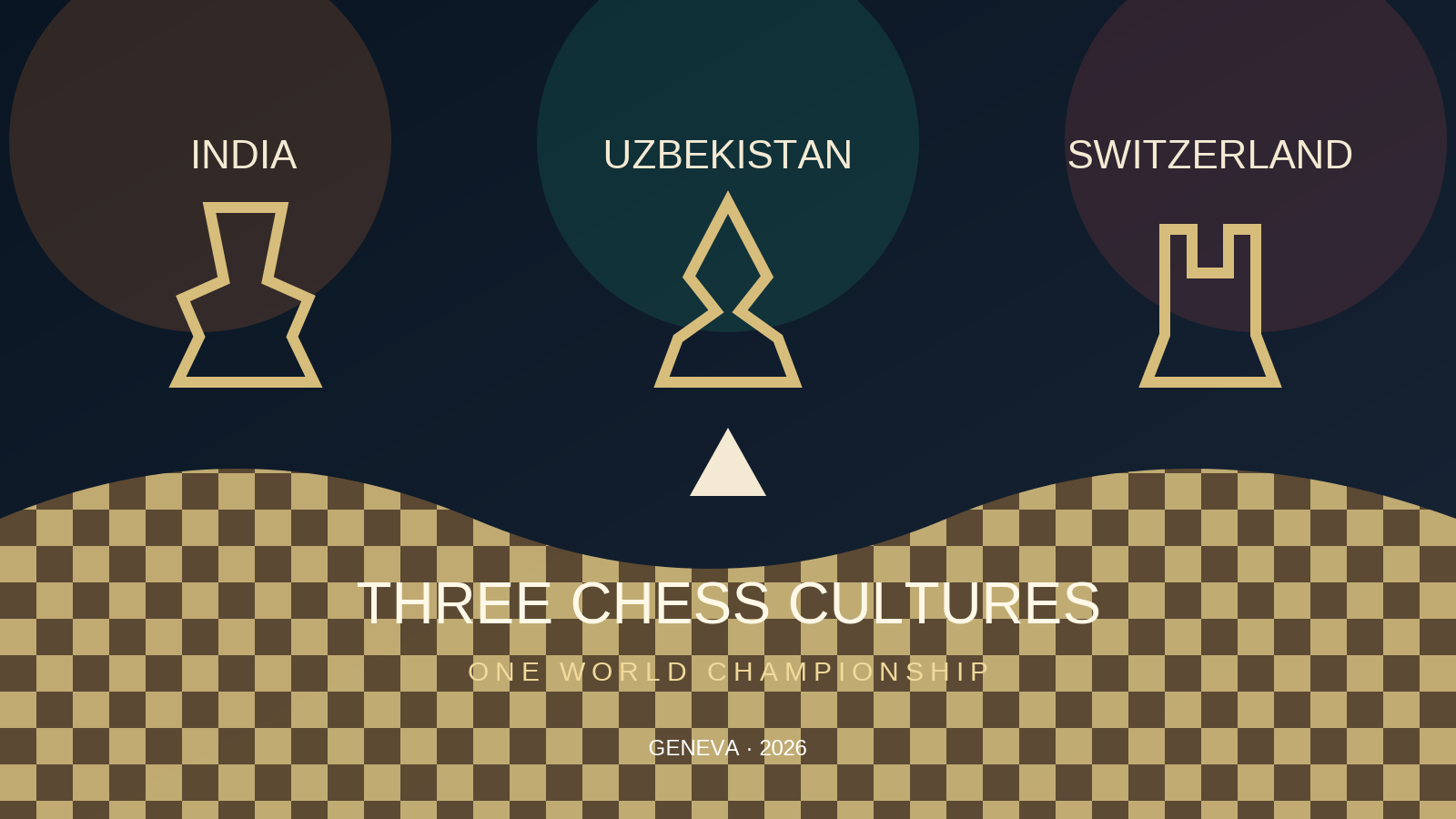
On the rest day in Geneva, the scoreboard reads Gukesh 1½–1½ Sindarov. Three games have established the tension of the 2026 World Championship, but they do not fully explain what has arrived at the board.
Gukesh Dommaraju represents an Indian chess movement that grew from one world-class pioneer into a broad ecosystem of families, academies, tournaments and online competition. Javokhir Sindarov is the first Uzbek challenger for the classical crown, the most visible product yet of a generation strengthened by team success and deliberate public investment. Around them, Switzerland supplies something different: not a comparable pipeline of present-day super-grandmasters, but a centuries-old club culture, landmark tournaments, public chess spaces and the institutional credibility of Geneva.
This is therefore more than a contest between two 20-year-olds. It is the latest scene in three much longer stories: a game remembered through ancient armies and Tamil temple lore; pieces recovered from the trading cities of Central Asia; and European clubs, tournament halls and park boards that made chess part of civic life.
India: where the ancient army became a modern movement
The most familiar opening to India’s chess story is also the one that requires the most care. Chess is widely believed to have developed from chaturanga in India around the sixth century, before related forms travelled through Persia and the Islamic world into Europe. The precise family tree is debated, and the rules of modern chess emerged over many centuries. India belongs at the centre of the game’s early history; modern chess did not appear there in its finished form.
The Sanskrit name evokes the four limbs of an army: infantry, cavalry, elephants and chariots. Their afterlives remain visible on a modern board in the pawn, knight, bishop and rook, even though names, powers and symbolism changed as the game travelled. Raja became the Persian shah; shah mat supplied the linguistic ancestry of “checkmate.” The board is therefore a small archive of movement between languages and empires.
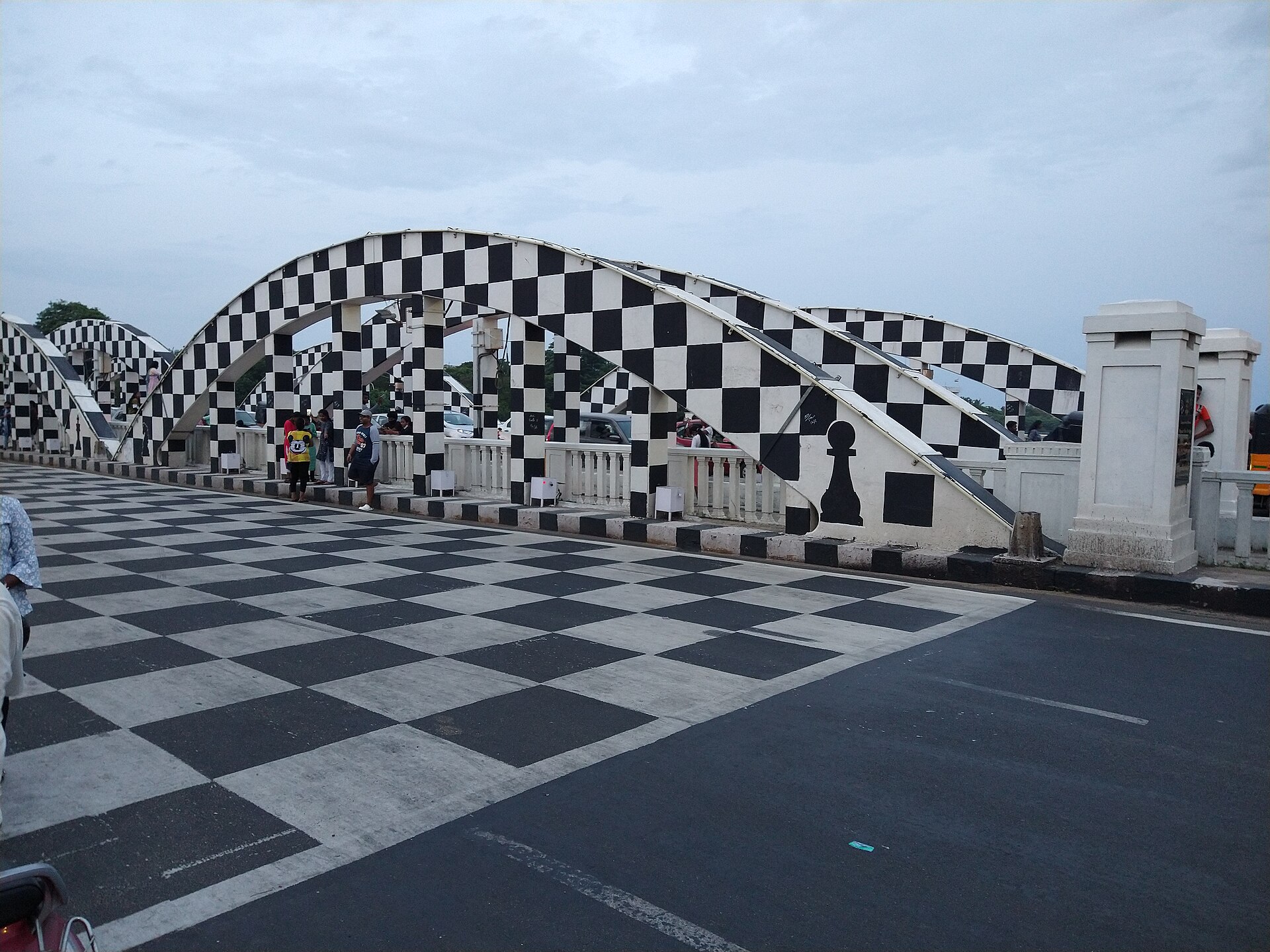
In Tamil Nadu, chess also lives in local story. The Chaturanga Vallabhanathar temple at Thirupoovanur is associated with a legend in which Shiva plays chess with a princess. During the 2022 Chennai Olympiad, that story became part of the state’s presentation of itself: not merely the host of a modern tournament, but a place where the game could be connected to sacred narrative, sculpture and language.

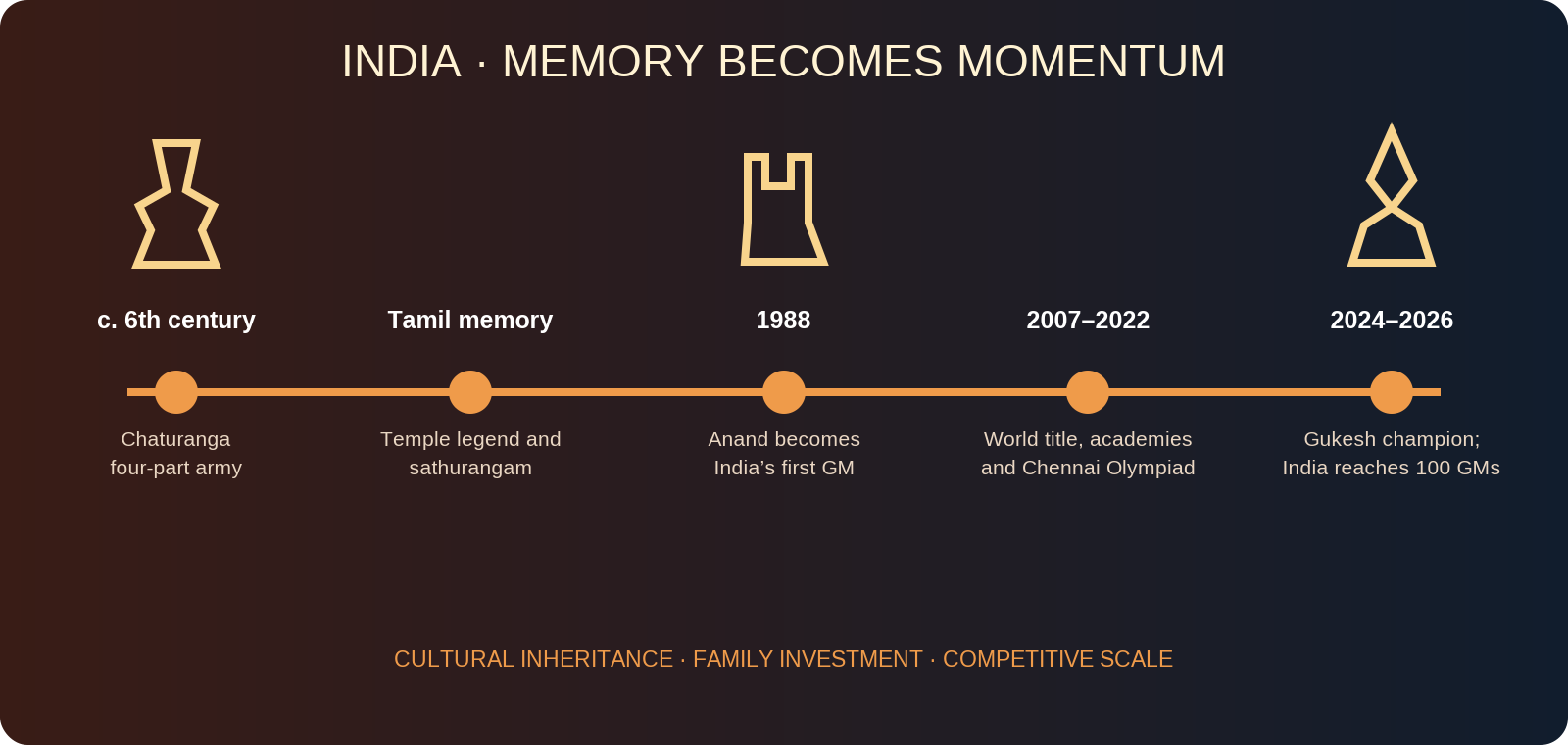
Ancient association did not automatically produce modern sporting strength. For most of the twentieth century, India had little international depth and received its first grandmaster only in 1988. That player, Viswanathan Anand, did more than accumulate titles: he made the highest level of chess visible and attainable to Indian families.
Anand became FIDE world champion in 2000 and won the unified championship in 2007. He later defended it in three different continents. His speed, calm public manner and longevity offered a particularly powerful example: an Indian player could reach the centre of a game long dominated by Europe and the former Soviet Union—and remain there.
The Anand effect became an ecosystem
Calling every subsequent success “the Anand effect” can hide the work that converted inspiration into opportunity. India’s rise also required coaches, parents willing to travel, tournament organizers, schools, sponsors, chess media and inexpensive online access.
Chennai became the bridge between cultural memory and competitive machinery. The Soviet Cultural Centre’s Tal Chess Club, school programmes, neighbourhood coaches and a dense tournament circuit gave aspiring players somewhere to move after learning the rules. “Chess city” is not merely a nickname earned by producing champions; it describes an urban network in which parents can find coaches, children can find rated events, and strong players continually encounter one another.
The 2022 Olympiad made that culture visible at city scale. Tamil Nadu deployed the black-and-white Thambi mascot, chessboard motifs and public celebrations across Chennai and Mahabalipuram. India 2 won bronze while 16-year-old Gukesh took individual gold on board one. Heritage, spectacle and a new generation briefly occupied the same frame.
Across the country, weekend tournaments gave young players repeated experience; online databases and engines reduced the distance from global chess knowledge; and families increasingly treated chess as a skill worth investing in rather than an eccentric pastime.
The results became visible in waves. India’s young teams won Olympiad medals. Players such as Pentala Harikrishna, Koneru Humpy, Harika Dronavalli, R Praggnanandhaa, Arjun Erigaisi, Nihal Sarin and Vaishali Rameshbabu broadened the image of what Indian excellence looked like. In November 2026, Anuj Shrivatri became India’s 100th grandmaster—a striking change from Anand standing alone in 1988.
That number is a milestone, not a complete health report. Access remains uneven. International travel is expensive, strong coaching clusters around particular cities, and many promising careers depend on extraordinary family sacrifice. Gukesh’s own path included leaving conventional schooling and a parent stepping away from regular work to accompany him.
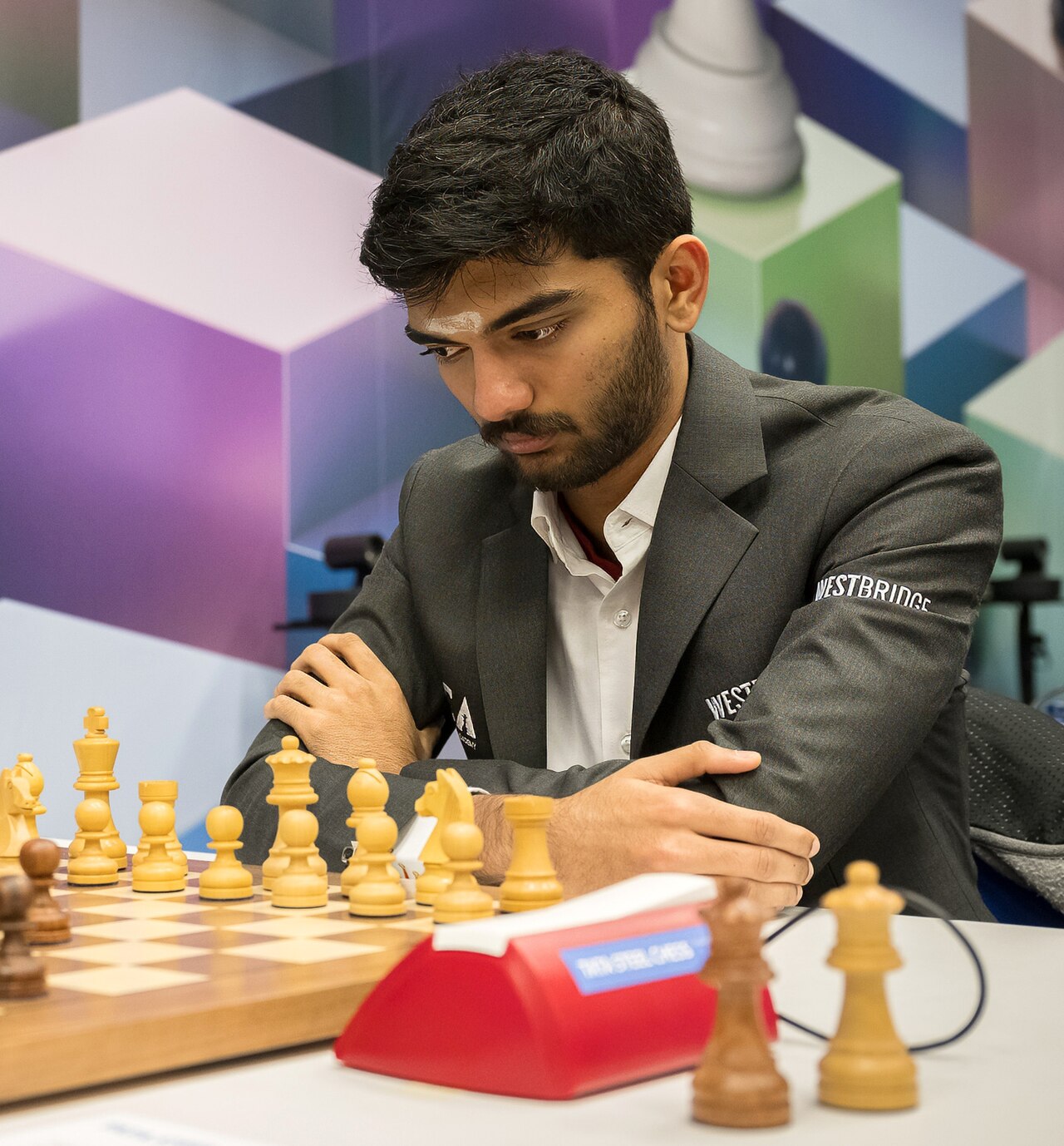
Yet this is precisely why India’s culture matters to the match. Gukesh is extraordinary, but he is no longer unimaginable. He emerged from a system crowded with ambitious peers, including several players capable of challenging the world’s elite. His 2024 championship victory made him the youngest undisputed world champion; his 2026 defence shows how quickly a singular breakthrough can become an ongoing national story.

Uzbekistan: chess pieces beneath the Silk Road, champions above it
Uzbekistan’s chess story combines antiquity with deliberate acceleration.
Archaeology gives Uzbekistan’s chess heritage a physical form. Pieces found at Dalverzin Tepe, an ancient settlement in the south, have been associated with the Kushan period. Finds from Afrasiab, the old city of Samarkand, include a group commonly dated to the seventh or eighth century. Their exact identification and dating remain subjects for specialists, but the objects place present-day Uzbekistan within the early Central Asian world through which chess forms travelled and changed.
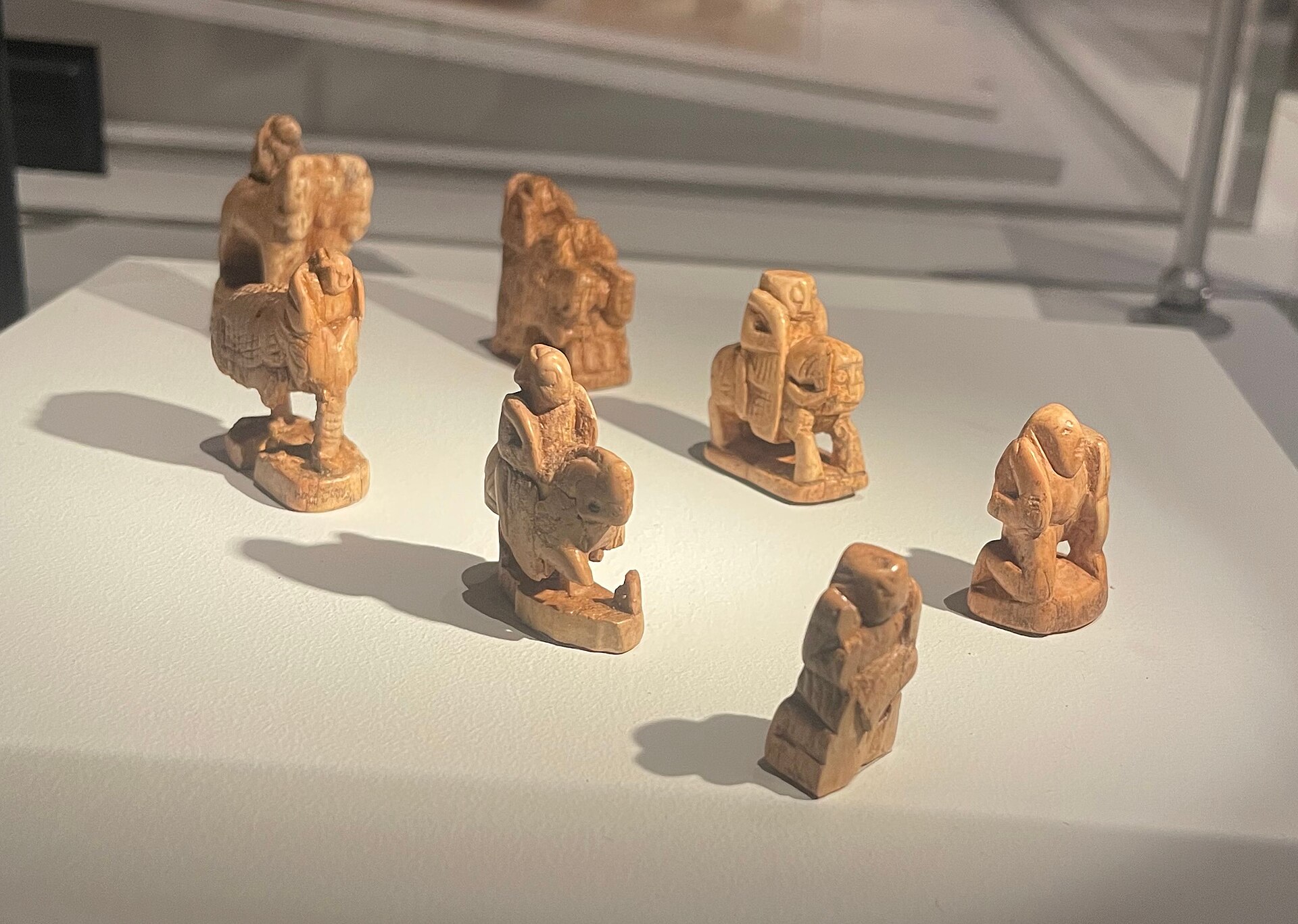

That geography matters. Samarkand and Bukhara were not isolated dots on a modern map. They belonged to networks that carried merchants, beliefs, languages and games between Iran, India, the steppe and China. Chess in Central Asia absorbed Persian terminology and developed regional forms; it could be played in courts and learned in the social spaces of towns. Uzbekistan’s strongest historical claim is therefore not that every form of chess began inside its current borders, but that the region became one of the game’s early homes and crossroads.
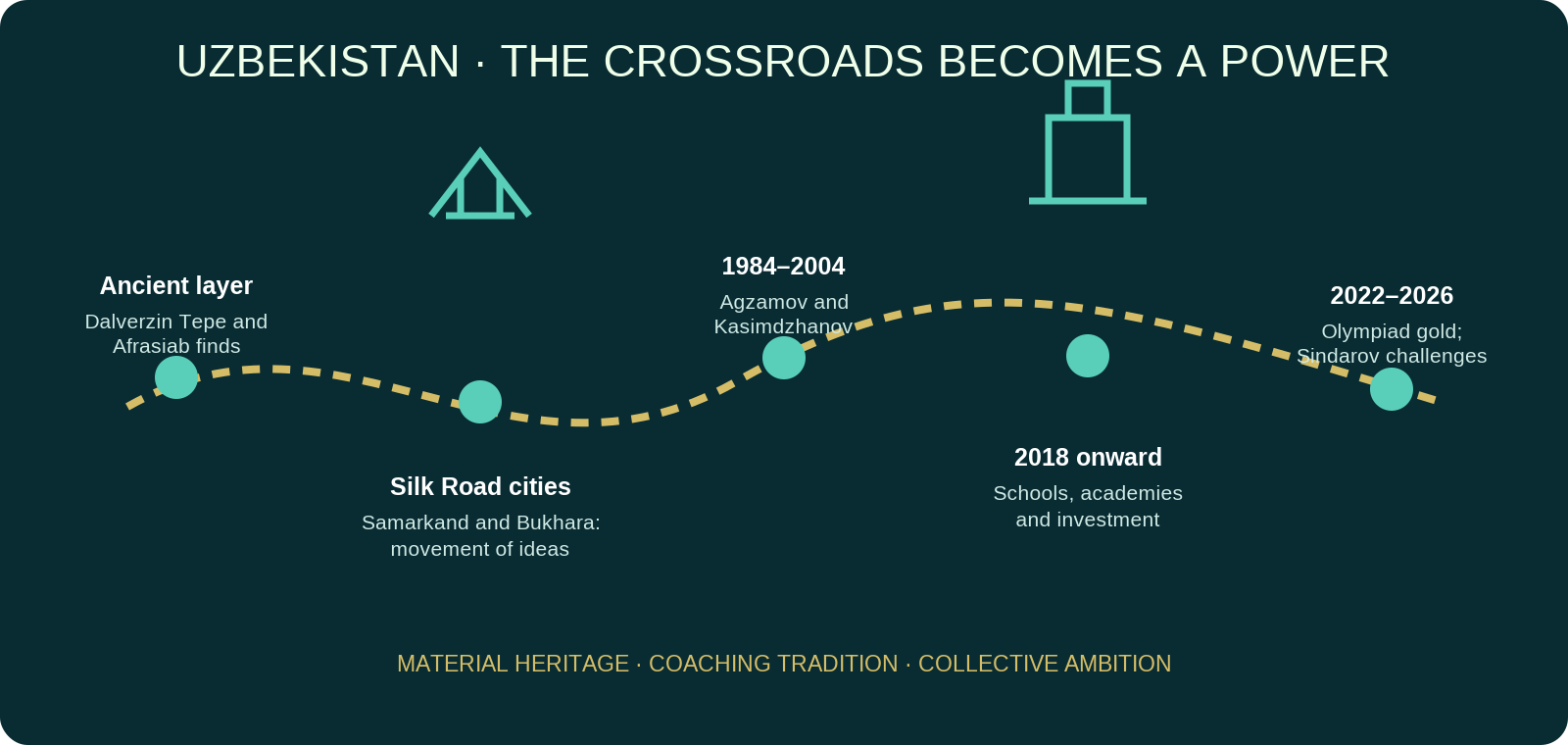
Modern competitive chess developed through the Soviet system of clubs, coaches and formal titles. Georgy Agzamov, born in Tashkent, became the first Uzbek grandmaster in 1984. Rustam Kasimdzhanov later won the 2004 FIDE knockout world championship and became both a national reference point and an influential elite coach. Their careers connect the current boom to expertise accumulated before today’s players were born.
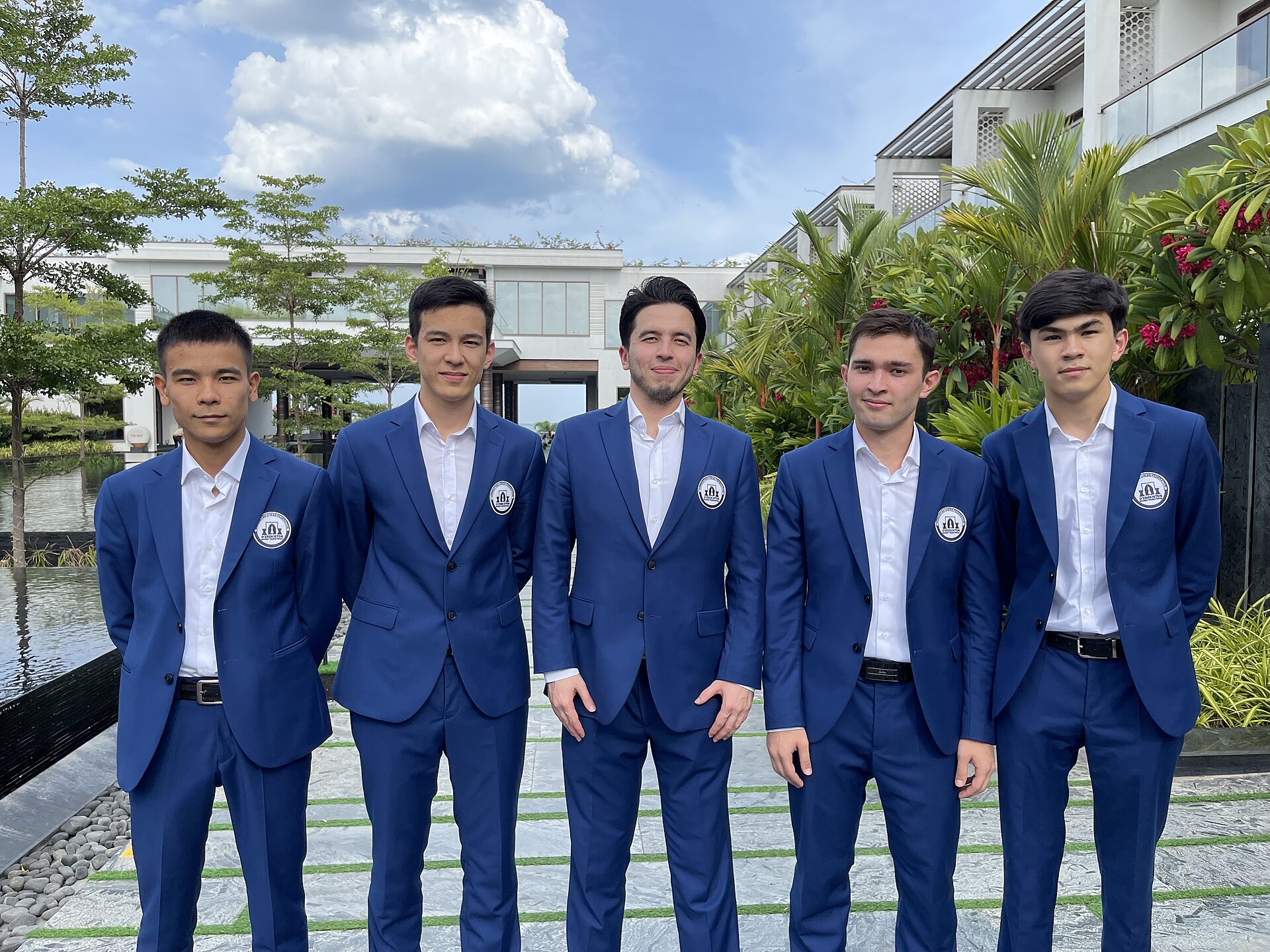
The current transformation, however, is collective. A generation led by Nodirbek Abdusattorov, Sindarov and Nodirbek Yakubboev began winning before its members had reached their mid-twenties. Uzbekistan took open-team gold at the 2022 Chennai Olympiad, confirming that these were not isolated prodigies. It won the Olympiad again on home ground in 2026.

When success and policy reinforce each other
Since 2018, government decrees and investment have expanded organized chess. FIDE’s account of the programme describes the extension of Chess in School, additional competitions and measures intended to develop coaching and elite players. A later decree widened the school programme and set ambitions for clubs, trainers and international events. Academies in Tashkent and tournaments at home supplied more regular high-level contact, while online play allowed the young cohort to test itself continuously.
This is not a simple tale of policy producing champions on command. Many of Uzbekistan’s strongest players were already exceptional children, and Soviet-era expertise did not disappear when the country became independent. The more persuasive explanation is a feedback loop: early talent earned international success; success increased public attention and funding; better structures allowed the next group to train and compete more consistently.
Sindarov embodies that loop. He learned chess at four, became a grandmaster before 13 and helped the 2022 team win gold. He then won the 2025 World Cup and the 2026 Candidates without losing a game. His rise has been individual, but it has never been solitary: he grew alongside teammates who made victory over established chess nations feel normal.
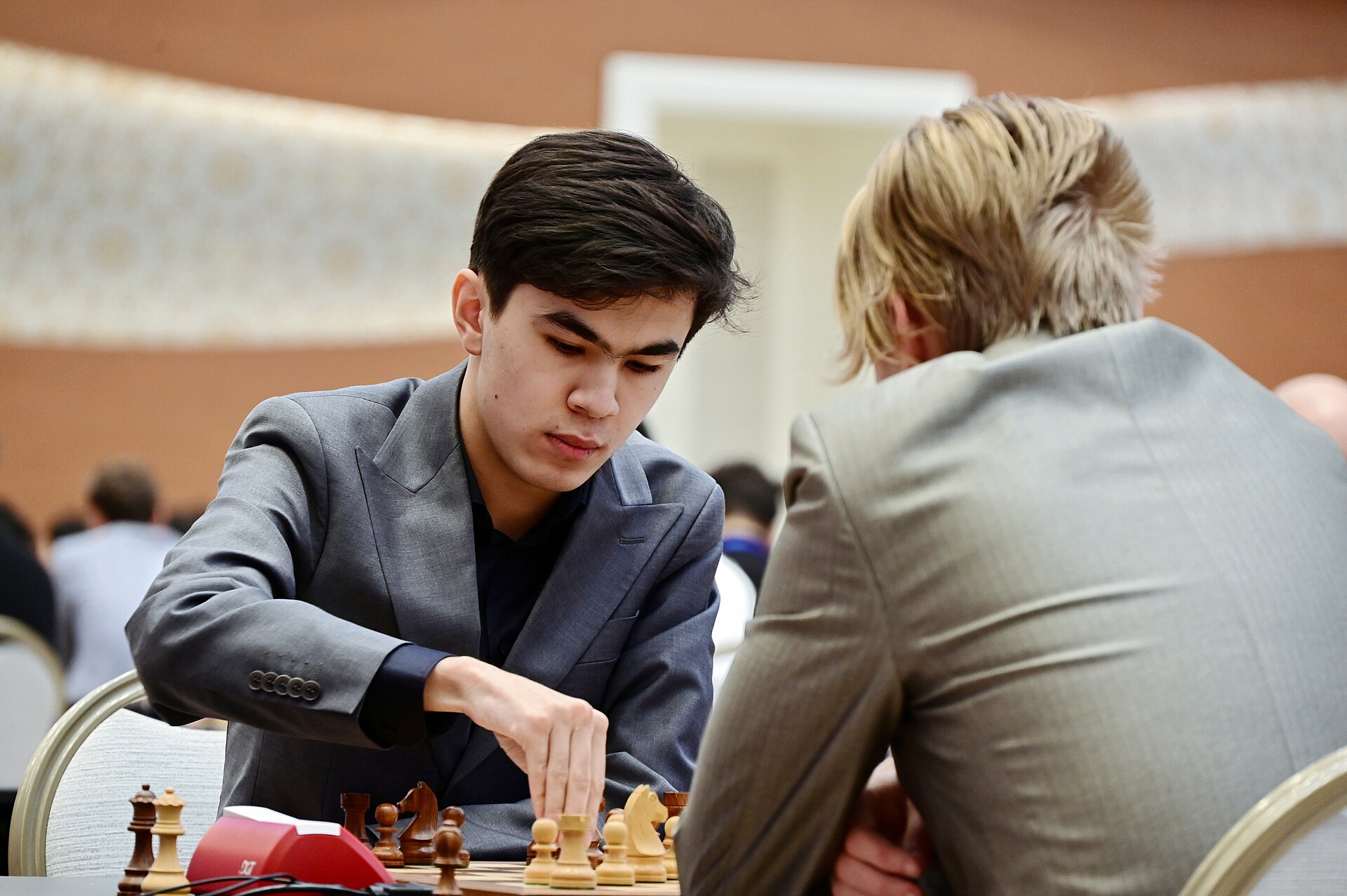

The state’s embrace of chess also shapes its public meaning. Players receive official honours; team victories become national occasions; and chess is presented as evidence of intellectual ambition. That visibility can inspire participation, although medal totals should not be confused with universal access or permanent dominance. Sustainable culture ultimately depends on teachers, local clubs and children continuing to play after the ceremony ends.
Sindarov’s challenge in Geneva is therefore a threshold moment. Kasimdzhanov held FIDE’s knockout title during the divided-title era. Sindarov is the first Uzbek to contest the undisputed classical championship in the traditional match format. A victory would not begin Uzbek chess history; it would give its newest chapter the game’s most recognizable crown.
Switzerland: two centuries of clubs, tournaments and chess in public
Switzerland enters this story differently. It has never produced a classical world champion, and its current player base does not rival India’s or Uzbekistan’s at the elite level. Its significance lies in longevity, organization and place.
The Schachgesellschaft Zürich was founded in 1809 and is one of the world’s two oldest chess clubs still operating, according to FIDE’s Historical Committee. Its survival offers a different kind of heritage from an excavated piece. A club creates records, rituals, regular opponents and organizers; it allows a culture to be renewed one meeting at a time. Today the Zürich regional association alone connects more than 30 clubs and roughly 1,200 players.
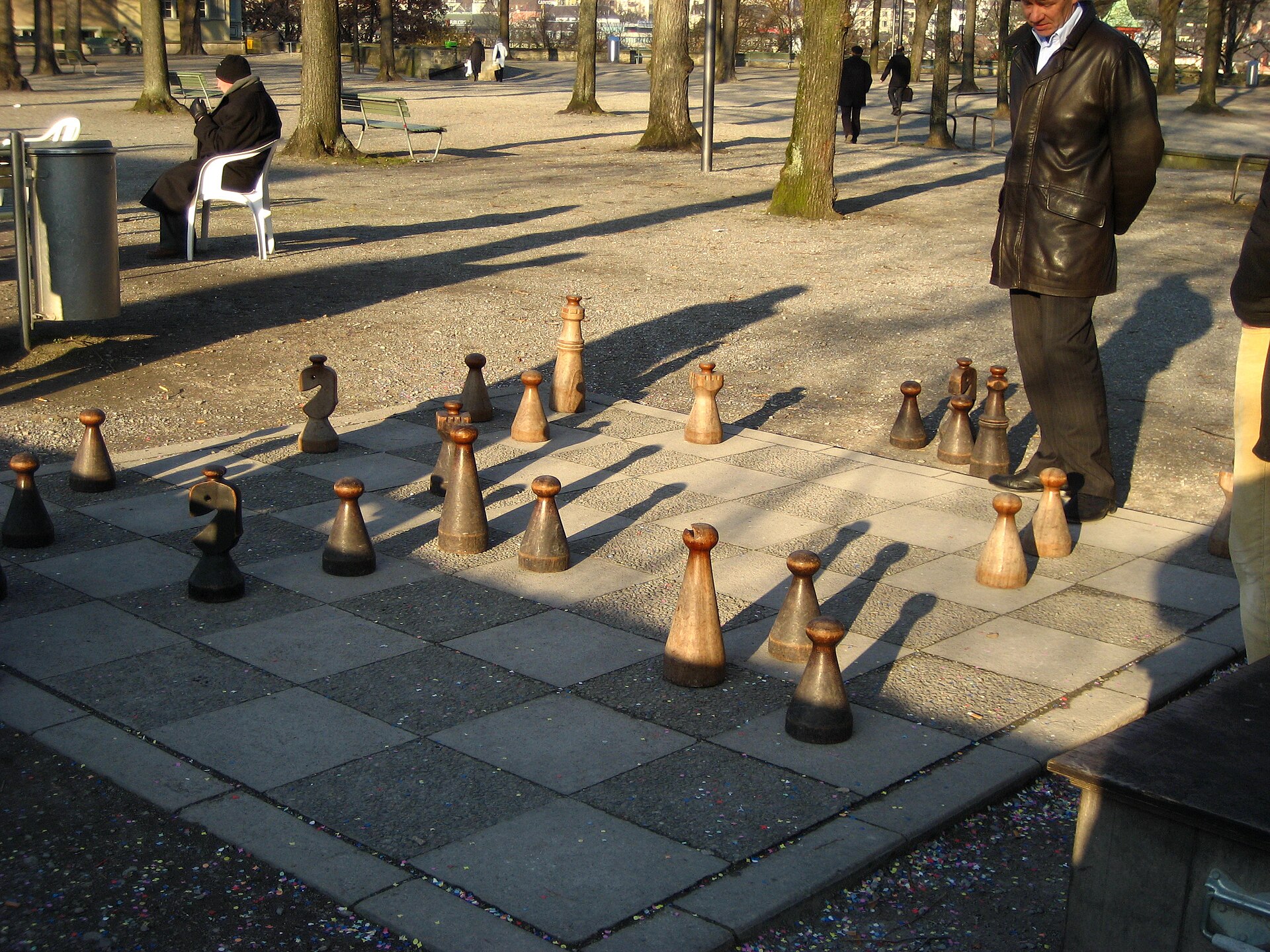

Switzerland has repeatedly converted that organizational tradition into stages for chess history. The 1953 Candidates tournament brought 15 leading players to Neuhausen and Zürich for a 30-round ordeal. Vasily Smyslov won the right to challenge Mikhail Botvinnik, while David Bronstein’s tournament book made the event live far beyond its hall. Biel’s chess festival, founded in 1968, grew into an annual meeting place for elite players, open competitors and the local public. In 2004, Vladimir Kramnik retained the classical title against Peter Leko in Brissago—the last defence of that lineage before reunification.
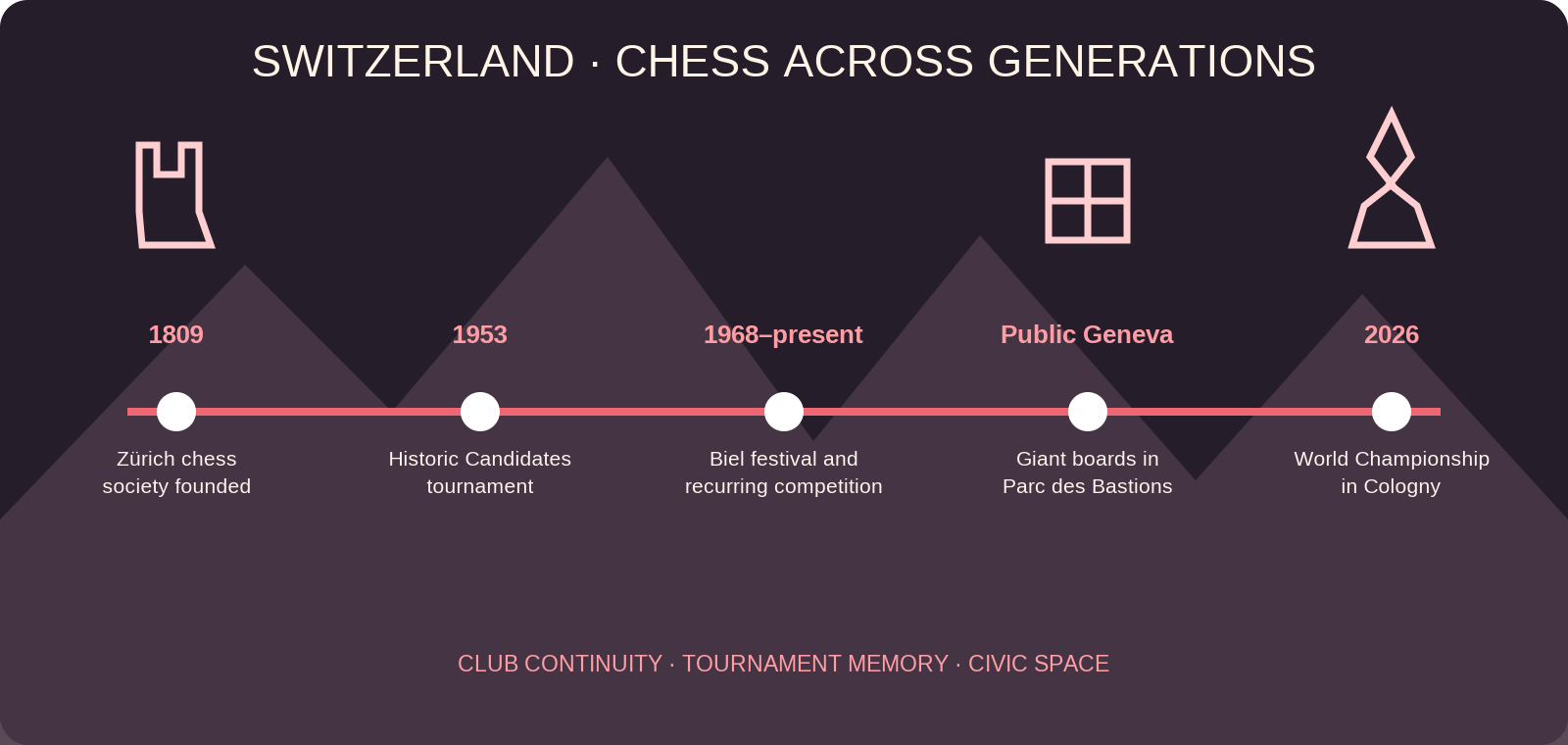
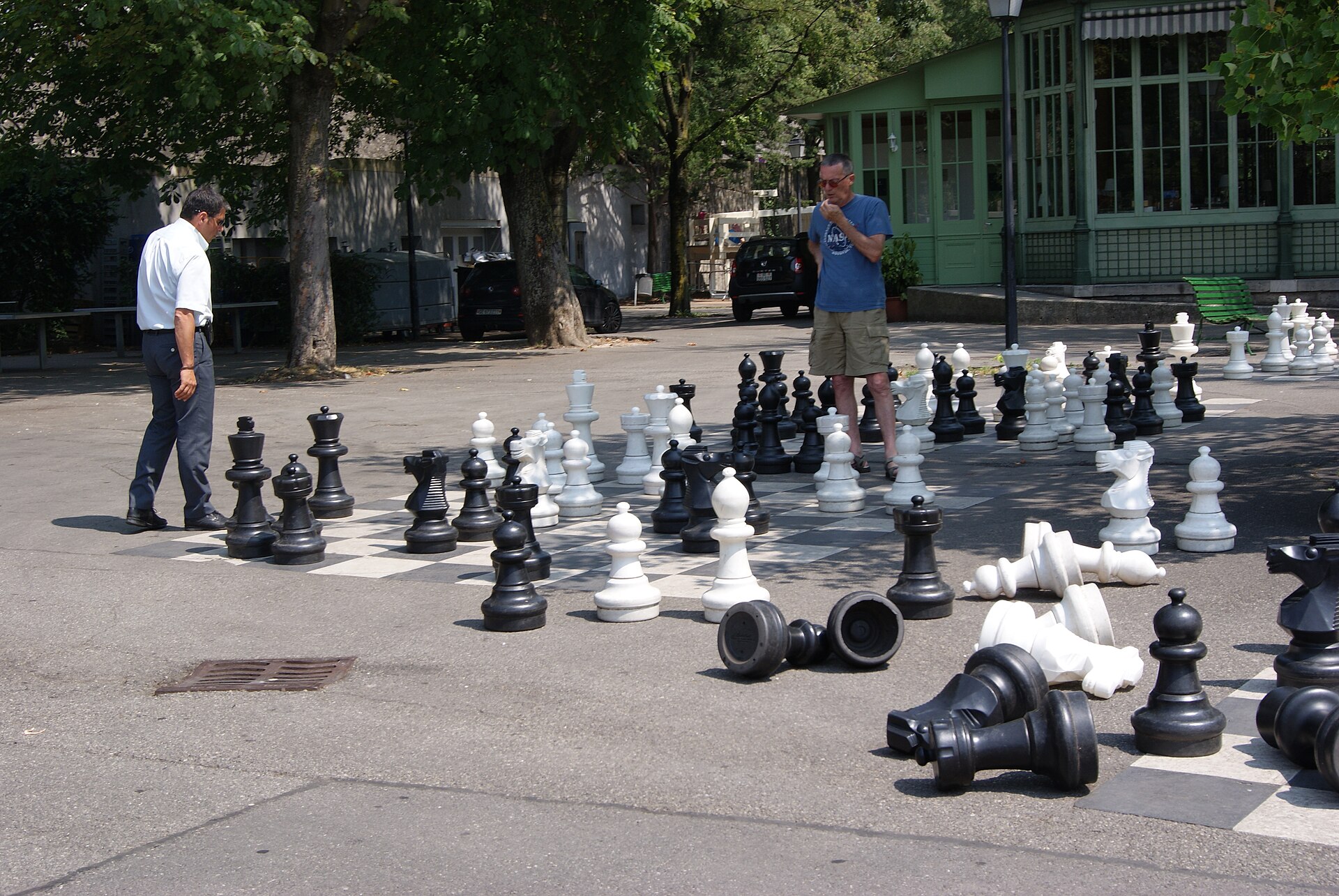
Then there is chess in public. In Geneva’s Parc des Bastions, beneath trees and close to the Reformation Wall, giant boards allow strangers, residents and visitors to play in the open air. The City of Geneva’s own cultural trail includes the park’s giant chessboards. They are not merely picturesque props. The players physically enter the board, lift the pieces and negotiate a shared space. No membership, appointment or rating is required—only an available opponent.

Why Geneva fits a world championship
Geneva’s international identity is inseparable from diplomacy and institutions. FIDE’s official match page presents the city as a place with a long association with international sport and dialogue. The match venue, the Fondation Martin Bodmer in Cologny, adds another layer: a museum and library devoted to written culture hosting a contest built from notation, memory and ideas.
“Neutral ground” is an easy phrase to use about Switzerland, but it should not flatten the host into scenery. A world championship needs organizers, spectators, local legitimacy and a setting that makes the contest feel consequential. Switzerland’s contribution is the accumulated capacity to stage chess—and the civic habit of giving the game space.
One board, three timelines
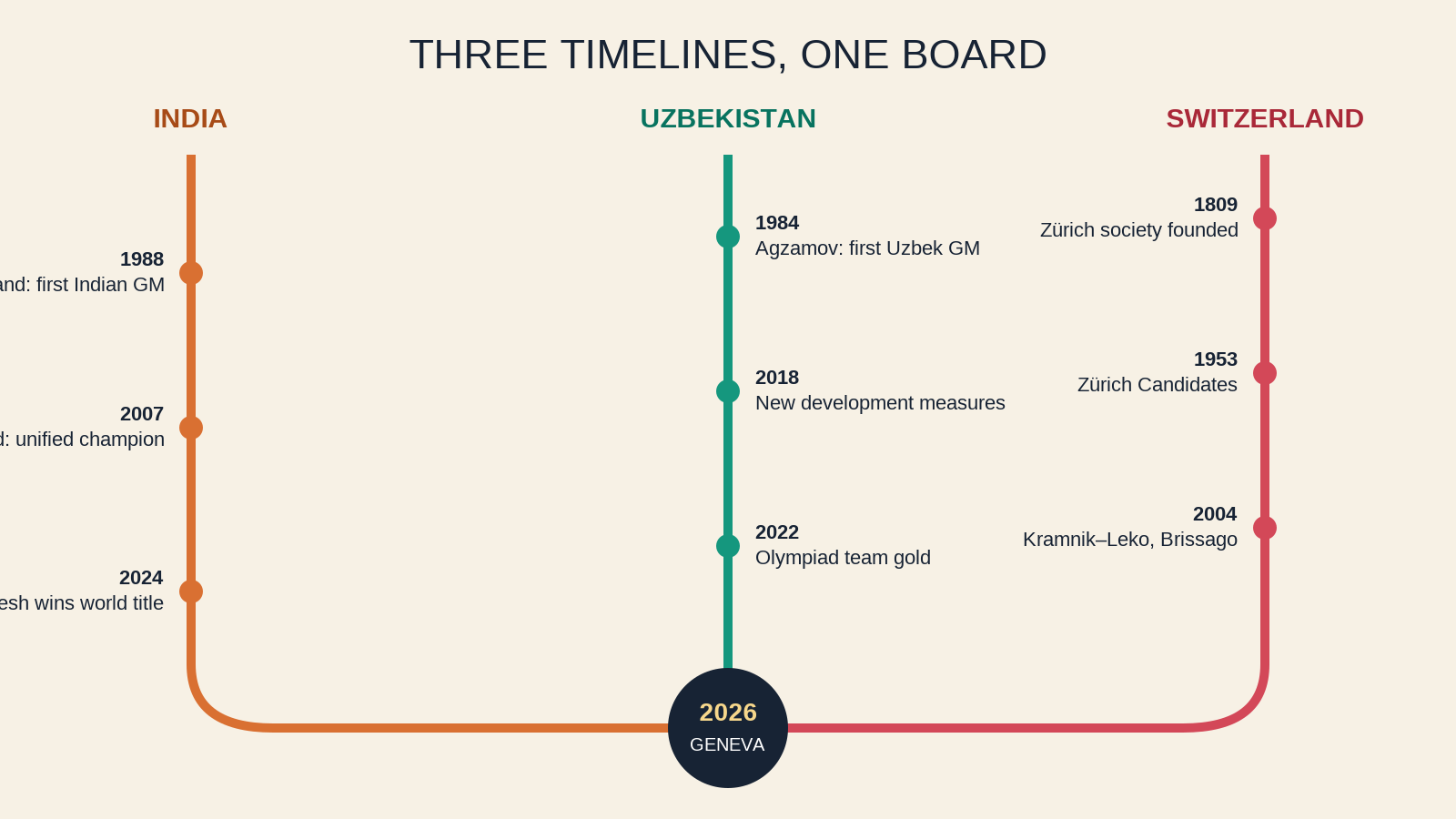
| Year | India | Uzbekistan | Switzerland |
|---|---|---|---|
| 1809 | — | — | Schachgesellschaft Zürich founded |
| 1953 | — | — | Zürich stages the Candidates tournament |
| 1984 | — | Georgy Agzamov becomes the first Uzbek GM | — |
| 1988 | Viswanathan Anand becomes India’s first GM | — | — |
| 2004 | Anand is already an elite title contender | Kasimdzhanov wins the FIDE knockout world title | Kramnik–Leko classical title match in Brissago |
| 2007 | Anand wins the unified world championship | — | — |
| 2018 | India’s junior wave is accelerating | Major new chess-development measures begin | — |
| 2022 | India 2 wins Olympiad bronze; Gukesh wins board-one gold | Uzbekistan wins open-team gold | — |
| 2024 | Gukesh becomes world champion | — | — |
| 2026 | India reaches 100 grandmasters | Uzbekistan wins Olympiad gold; Sindarov wins the Candidates | Geneva hosts Gukesh–Sindarov |
What each culture contributes—and what the comparison teaches
India demonstrates the compounding power of a role model. Anand’s success mattered because institutions and families multiplied it. The important unit is no longer one prodigy but a competitive population.
Uzbekistan demonstrates how a small country can concentrate expertise and momentum. Its best players developed as a cohort, and team victory made chess useful to a larger national story. Public investment then gave that success more places to reproduce itself.
Switzerland demonstrates the value of continuity without dominance. A country does not need the reigning champion to sustain meaningful chess culture. Clubs that survive for generations, tournaments that recur, and boards embedded in public space can give the game a durable civic home.
These are not recipes that can simply be copied. India’s scale is unique; Uzbekistan’s political and sporting institutions are its own; Switzerland’s club tradition grew across two centuries. But together they suggest four conditions that help chess thrive:
- A visible path: people need champions or events that make ambition imaginable.
- Places to play: schools, clubs, academies, tournaments, parks and online rooms each serve different players.
- Knowledge that persists: coaches and institutions must carry expertise beyond one exceptional generation.
- A public story: chess expands when a society can connect the game to education, identity, community or prestige—without reducing it to propaganda.
The match resumes, but the larger encounter continues
Game 4 begins on 28 November with Gukesh playing White. The immediate questions will again be concrete: which opening appears, who controls the clock, where the first imbalance begins. Those details decide championships.
But the rest day offers a wider view. Gukesh and Sindarov did not emerge from nowhere, and Geneva is not an interchangeable backdrop. Behind the champion stands a vast Indian movement that turned one pioneer into a hundred grandmasters. Behind the challenger stands an Uzbek generation that converted youthful promise into team gold and a title challenge. Around them stands a Swiss tradition that has given chess clubs, public squares and international stages for more than two centuries.
Only one player can leave Geneva as world champion. All three chess cultures are already visible on the board.
Continue following the championship
- World Chess Championship history
- Gukesh vs Sindarov: profiles, rivalry and pre-match analysis
- World Championship match hub
- Games and results
Research and editorial note
This feature distinguishes archaeological evidence, national traditions and documented modern programmes from promotional claims about the “birthplace” of chess. It does not treat grandmaster counts as the sole measure of culture. Match information was checked through the official FIDE World Championship site; historical and institutional claims were checked against FIDE materials, municipal or federation sources, and reported features. Claims that may change—rankings, title counts and match score—are stated as of the reporting cutoff above.
Core references: FIDE on the 2026 host; FIDE Historical Committee on nineteenth-century chess and Zürich; FIDE on Uzbekistan’s chess decree; Indian Express on India’s rise after Anand; Indian Express on chaturanga and chess’s transmission; Eurasianet on Uzbekistan’s modern chess investment; Zürich Chess Association.
Photograph licensing
All documentary photographs embedded in this article were downloaded from their Wikimedia Commons source pages on 27 November 2026. Each caption identifies the creator, source and Creative Commons licence. Local copies were resized for web delivery without editorial alteration. The original SVG illustrations are supplementary visual explanations and should not be presented as documentary images.
Gukesh vs Sindarov · Compare Gukesh and Sindarov · Chess cultures of India, Uzbekistan and Switzerland · Where to watch the match live · Schedule and results · Latest stories